What the transit means
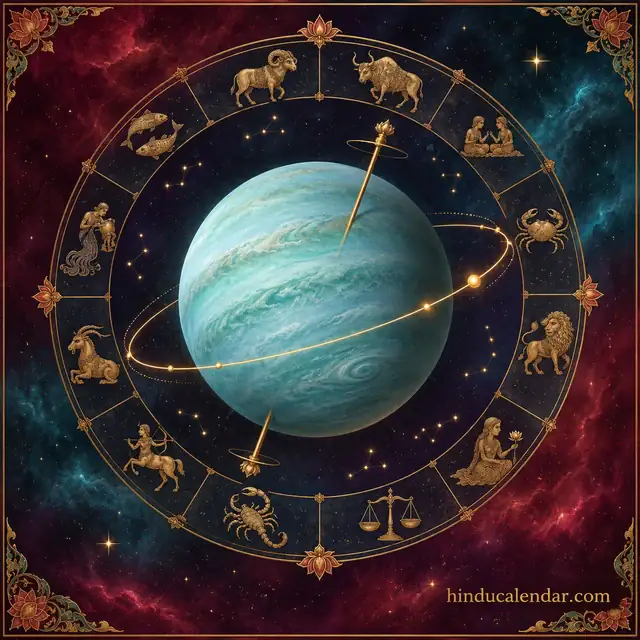
Because Aruna takes about 84 years to circle the zodiac and stays about seven years in a sign, its transit is a generational marker more than a personal one, though it matters when it crosses a sensitive point of a chart, such as the natal Moon or the ascendant. Those who follow it expect sudden changes of residence, work or relationships, breaks with the past, and a stronger interest in science, technology and unconventional ideas.
How it is read
There are no classical favourable and unfavourable houses for Aruna. Astrologers who use it look at the house of the natal chart through which it passes, to see which area of life is being disrupted or freed, and at its aspects to the natal grahas, especially the Sun, Moon and ascendant lord. It is read as a slow, background influence and is never given the weight of Saturn or Jupiter, which are the classical timekeepers of life.
How gochara is read
In Vedic astrology the transit is judged from the sign of the natal Moon, the Janma Rashi, which you can find with the Moon Sign Calculator: the sign the graha is in now is counted as the first, second, third and so on house from it. The Moon is chosen since it is the mind, and the transit is said to show how things are felt and met. Some astrologers also count from the ascendant.
A transit is only one layer. The classical texts add the rule of vedha, by which a graha in a house that gives good results can be blocked by another graha in a particular house, and the modern Ashtakavarga method weights each transit by the points the sign has in the birth chart. The period (dasha) running at the time, and the strength of the graha in the birth chart, decide how much of the result shows.
Worship and remedies
The texts give no remedies for Aruna. People who follow it usually apply those of the graha it is compared to, Rahu, and of Shani, since both are slow and demand adjustment: patience, service, worship of Shiva and Durga, and calm routines in times of upheaval. The reasonable view is that it is useful for understanding the times, but not for fixing the dates of events in a single life.