The katha
In a kingdom lived a potter whose kiln would not fire: however long he burned it, the pots came out unbaked. He went to the king, and the royal priest said that a child would have to be sacrificed in the kiln. The king ordered that each family should give a child in turn. When the turn came to a poor old woman, she had only one son.
It was the day of Sakat Chauth. She gave her son a handful of sesame and a blade of durva grass, and told him to pray to Sakat Mata and Ganesha inside the kiln. She herself kept the fast all day and prayed. The next morning, when the potter opened the kiln, the pots were perfectly fired, and the boy sat among them alive and well. Even children put in on earlier turns were found alive. The king and the people were amazed, and the whole kingdom began to keep the Sakat Chauth fast.
The legend of Lambodara
In the Mudgala Purana, Lambodara is the avatar of Ganesha who defeated Krodhasura, the demon of anger. Riding a mouse, Lambodara subdued the demon, who surrendered and was spared. His great belly is said to hold the whole universe and to digest whatever bitterness the world gives.
Keeping the fast
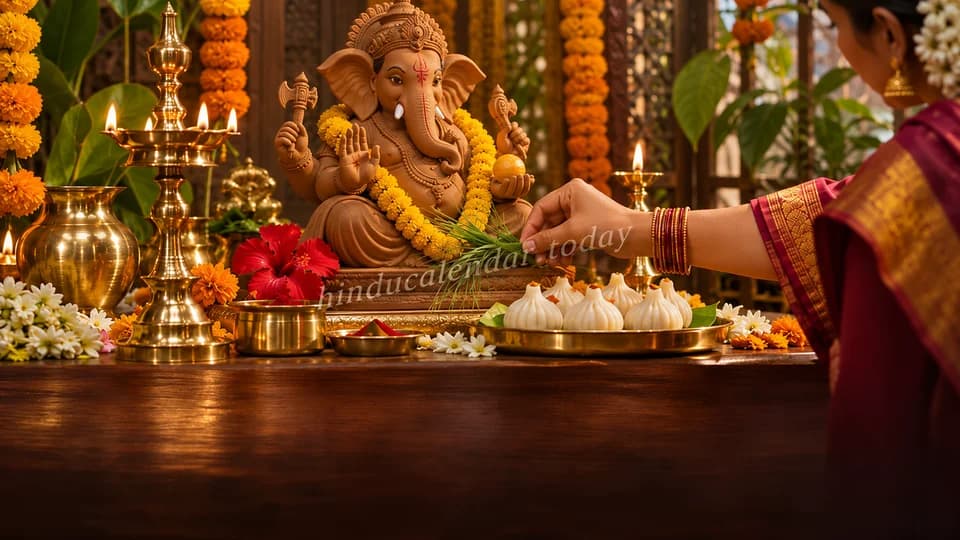
The fast is kept from sunrise to moonrise. In the evening Ganesha is worshipped with durva grass, red flowers, modak or laddoo of sesame and jaggery, and the katha of the month is read. When the Moon rises it is offered water (arghya) with sandal, rice and flowers, and only then is the fast broken.
On Sakat Chauth sesame and jaggery are pounded into tilkut, offered to Ganesha and given away, and mothers break the fast after offering water to the Moon.