The legend of Ekadanta
The sage Chyavana, the Mudgala Purana says, once created a being of intoxication, Madasura, who became a fierce demon. Shukracharya taught him the mantra of the goddess, and with her boon he conquered the earth and heaven and ruled with arrogance. The gods suffered and prayed to Ganesha, who came as Ekadanta, riding a mouse, with one tusk.
Ekadanta sent Narada to Madasura to warn him to give up his conquests. The demon laughed and came out to fight. When Ekadanta showed himself, Madasura's pride collapsed: he saw that his strength came only from the boon, and that his opponent was beyond any boon. He fell at Ekadanta's feet, and was spared and sent to the underworld, where he would trouble no one who worshipped Ganesha.
How Ganesha lost a tusk
Several stories explain the single tusk. In one, Parashurama came to Kailasa to see Shiva, and Ganesha, guarding the door, would not let him in. They fought, and Parashurama threw the axe Shiva himself had given him. Out of respect for his father's weapon, Ganesha did not resist it, and took the blow on one tusk, which broke. In another, when Vyasa needed a scribe for the Mahabharata, Ganesha broke off his tusk to use as a pen so that the writing would not stop.
Ekadanta is read as a sign of one-pointed attention and of sacrifice for knowledge.
Keeping the fast
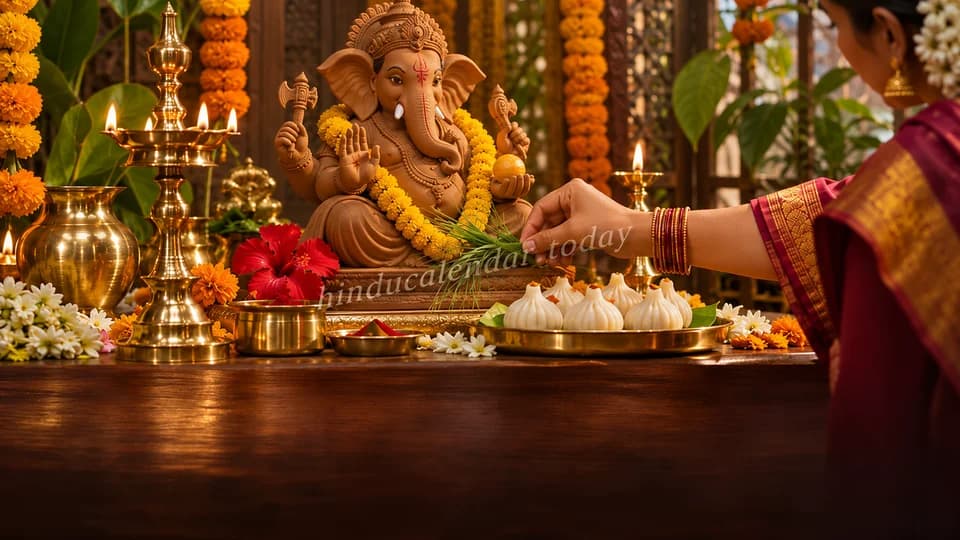
The fast is kept from sunrise to moonrise. In the evening Ganesha is worshipped with durva grass, red flowers, modak or laddoo of sesame and jaggery, and the katha of the month is read. When the Moon rises it is offered water (arghya) with sandal, rice and flowers, and only then is the fast broken.