The legend
Ravana, the king of Lanka, worshipped Shiva on Kailash and wished to take him to Lanka. He offered his ten heads one by one, and Shiva, pleased, restored them like a physician and gave him a lingam, on the condition that it must not be set down on the way. If it touched the ground, it would stay there for ever.
The gods feared Ravana would become unconquerable. On the way, Ravana felt the need to stop, and Vishnu, disguised as a cowherd, offered to hold the lingam. He set it down, and it stayed fixed to the spot at Deoghar. Ravana could not lift it and, in anger, pressed it with his thumb before leaving.
The temple and its worship
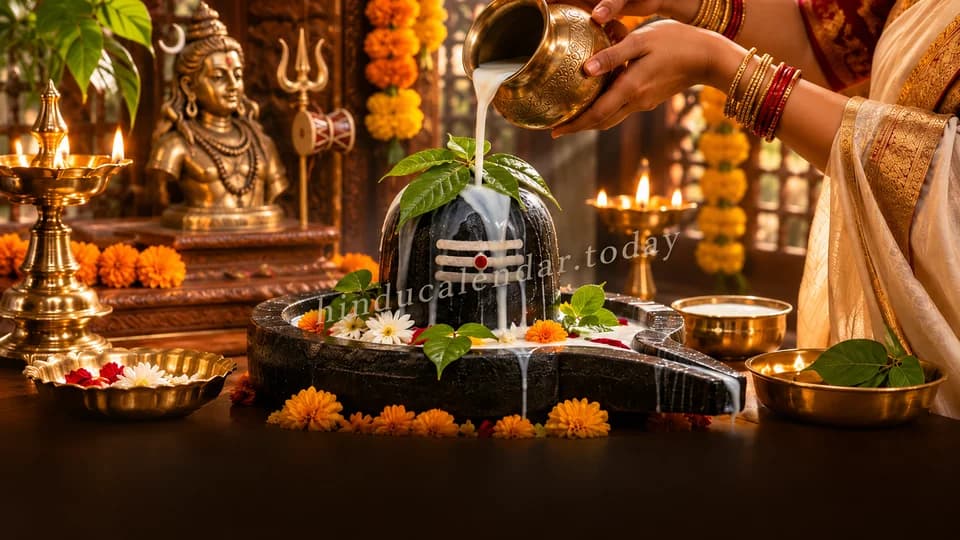
Deoghar is also a Shakti Peetha, where the heart of Sati is said to have fallen. In the month of Shravan, millions of kanwariyas walk barefoot about 100 kilometres from Sultanganj, carrying water from the Ganga to pour on the lingam, in the Shravani Mela.
The stotram places Vaidyanatha at Parali, which many read as Parli Vaijnath in Maharashtra; that temple also claims the Jyotirlinga, and both are honoured by pilgrims.
Among the twelve Jyotirlingas
Vaidyanath is the fifth of the twelve Jyotirlingas in the order of the Dwadasha Jyotirlinga Stotram, the short hymn that names all twelve. A jyotirlinga is a lingam of light, a place where Shiva is believed to have appeared as an endless pillar of fire. The hymn promises that whoever recites the twelve names morning and evening is freed from the sins of seven lives, and many devotees hope to visit all twelve in their lifetime.