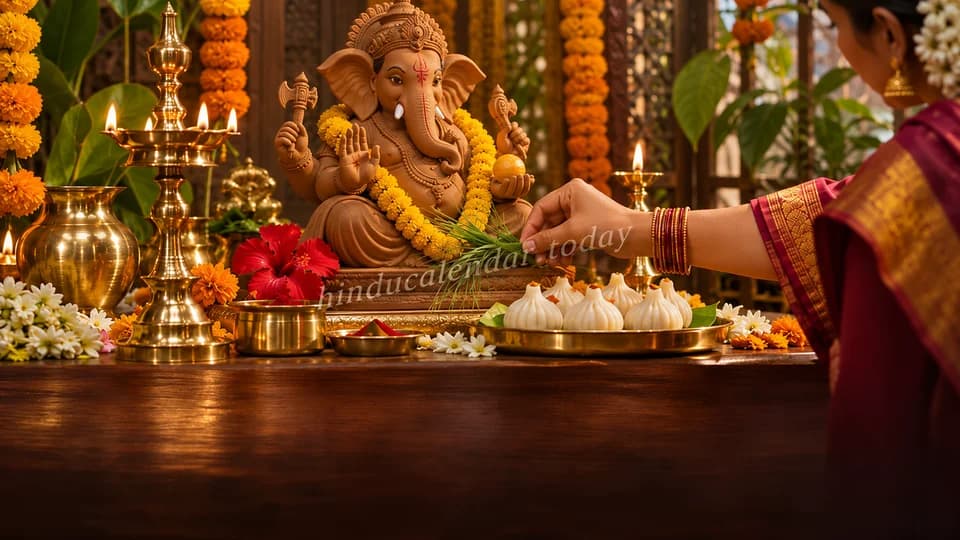
His form
He is red, with a large round belly, and sits on a mat of kusha grass, the grass used in Vedic rituals. In his six hands he holds the noose, the goad, a twig of the kalpavriksha, a lotus, his broken tusk and a pomegranate.
His belly, Lambodara, holds the universe, a sign that everything lies within the divine and that he can accept all that life brings without being shaken.
Meaning and worship
Prasada means grace or the state of being pleased. This form is worshipped by those who ask that their small efforts be accepted and rewarded. He does not need great rituals; simple, sincere worship pleases him quickly.
The seat of kusha grass ties him to the household rituals of daily life, where kusha is used for purification, and he is often invoked at the start of such rites.
Among the thirty-two forms
Kshipra Prasada Ganapati is the twentieth of the thirty-two forms of Ganesha, the Dwatrimsha Ganapati. Each form is known from a dhyana shloka, a verse for meditation that gives its colour, its arms and what each hand holds, so that the worshipper can picture it clearly. The best-known collection of these verses, with a painting of each form, is the Sritattvanidhi compiled at the court of Mysore in the nineteenth century. Details differ a little between texts and temples, so an image in a temple may not match every point given here.