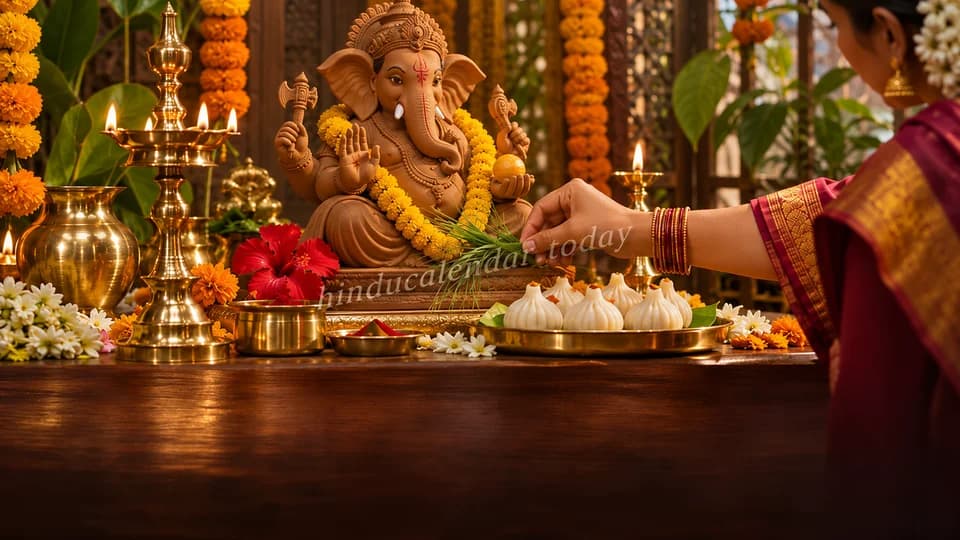
His form
The dhyana verse describes a chubby, playful child with the glow of dawn. In his four hands he holds a banana, a mango, a piece of sugarcane and a jackfruit, and his trunk curls around his favourite sweet, a modaka. He wears a garland of flowers and is often shown seated or crawling, with the innocent face of an infant.
The fruits stand for the abundance and fertility of the land. Because they are things a child loves to eat, the image is also tender and approachable: this is the Ganesha whom a family welcomes into the home as one of its own children.
Meaning and worship
Bala Ganapati is worshipped for the health and growth of children, for a child who is slow to speak or learn, and at the start of anything new that has to grow slowly, such as a business or a field newly sown. Parents offer him bananas, sweets and red flowers.
In a wider sense the child form is a reminder that wisdom begins with simple joy and curiosity, and that the divine can be loved with the ease with which a child is loved.
Among the thirty-two forms
Bala Ganapati is the first of the thirty-two forms of Ganesha, the Dwatrimsha Ganapati. Each form is known from a dhyana shloka, a verse for meditation that gives its colour, its arms and what each hand holds, so that the worshipper can picture it clearly. The best-known collection of these verses, with a painting of each form, is the Sritattvanidhi compiled at the court of Mysore in the nineteenth century. Details differ a little between texts and temples, so an image in a temple may not match every point given here.