Garba
The name comes from garbh, the womb, and from the garbo, a clay pot pierced with holes with a lamp burning inside, which stands at the centre of the dance. The pot is the womb of life and the body, and the light within is the goddess, the spark of the divine in every being. Women, and now men too, dance in widening circles around it, clapping and turning, to songs in praise of Amba. The circle itself stands for the cycle of time, from birth to death and rebirth, with the goddess unmoving at its centre.
Dandiya Raas
Dandiya Raas is danced in two lines or circles of partners, each holding two decorated sticks (dandiya) which they strike against their partners' in rhythm, moving on to a new partner with each turn. The sticks are said to be the swords of Durga in her battle with Mahishasura; the raas also recalls Krishna's dance with the gopis of Vraja.
The nights
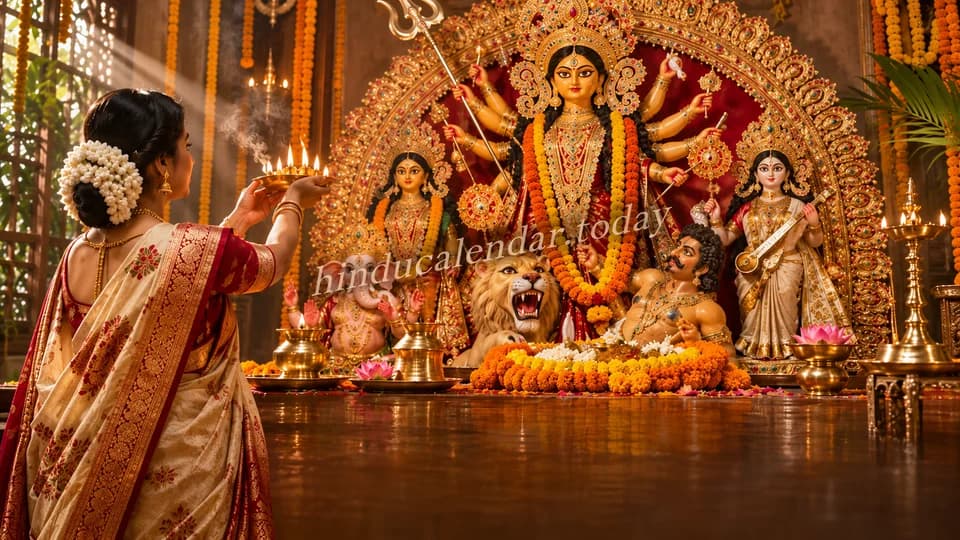
Each night begins with the aarti of the goddess, and the dancing follows to live music on dhol and shehnai, and today to large bands and sound systems. Dancers wear bright traditional clothes: chaniya choli for women, kediyu and dhoti for men, with mirror work and silver jewellery. The dances usually begin with slow steps and build in speed through the night.