Lord Indra (King of the Gods)
Devaraja Indra, the god of rain and king of heaven: Indra as a position, his origin in the Rigveda, his court and family, the fourteen Indras of the Manvantaras, his mantras and temples.
About Lord Indra
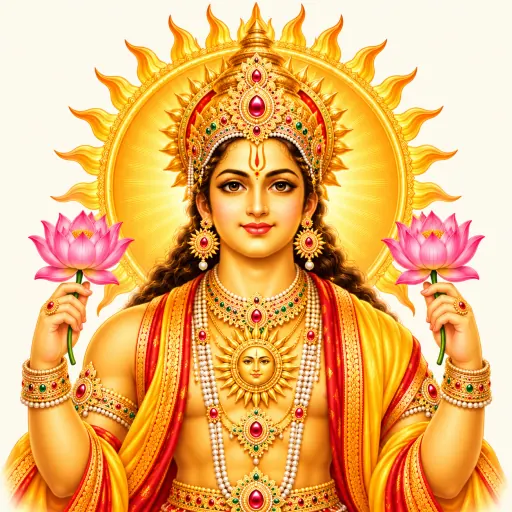
Lord Indra is one of the most popular deities described in the Hindu scriptures. He is shown as the God of Rain. As the king of the gods he is known as Devaraja Indra. From various mythological references Vedic scholars believe that Indra is not a particular individual but the name of a Pada, a designation, which stands for the highest position in the heavenly world, Swarga Loka. In the Eighth Skandha of the Devi Bhagavata Indra is described as one of the Ashta-Dikpalas, and his capital is known as Amaravati.
With the change of each Manvantara a new Indra is appointed; each Manvantara has its own Indra, and in the present Manvantara the ruler of Swarga Loka is the Indra named Purandara.
Devaraja Indra rules over heaven. His throne is called the Indrasana and his royal court the Indra Sabha. Indra holds a position of great importance in the Vedas. The fullest descriptions of Indra are found in the Rigveda, where about 250 hymns and more than 50 mantras are dedicated to him.
Origin of Devaraja Indra
Indra is generally described as a title rather than a single personality. According to the belief, one who performs 100 Ashvamedha Yajnas attains the position of Indra. Various accounts of the origin of Indra are found in the scriptures. In one place Indra is described as having come out of Soma. According to the 18th hymn of the Fourth Mandala of the Rigveda, Indra was born from the womb of Devmata Aditi. At the time of his birth a demoness named Kushava tried to kill him, but Indra killed her.
Indra is very fond of Soma Rasa and is described as drinking a great deal of it; Soma Rasa gives him strength and vitality. In his battle with the demon Vritra Indra drank Soma Rasa from three sarovaras, whole reservoirs full of it. In the 119th hymn of the Tenth Mandala of the Rigveda Indra is shown praising his own heroic deeds, strength and valour after drinking Soma Rasa. Indra is also regarded as the protector of Soma.
Indra defeated many demons, among them Vritrasura, Namuchi, Ahi, Rohina, Shambara, Urana, Vishvarupa, Arbuda, Bala and Vyansha. In the Vedas Indra is shown as a benefactor, protector and friend of his devotees.
In the Puranic pantheon Indra is the king of the gods, Devendra. He lives in Amaravati, the capital of the celestial world, where the divine Nandana Garden, adorned with the Kalpavriksha, Parijata flowers, Hari Chandana and Mandara trees, is situated. His royal court is called Sudharma, and his council has a thousand ministers. His consort is Shachi, also known as Indrani. His vehicle is Airavata, the celestial elephant obtained during the churning of the ocean, and his divine horse is Uchchaihshrava. Indra wields celestial weapons such as the Vajra and the Ashani.
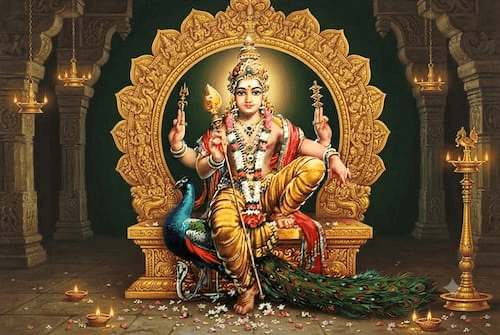
According to various mythological narratives, whenever any being does severe penance to gain the throne or position of Indra, Indra becomes anxious for the safety of his throne. To protect his position he sends Apsaras, celestial nymphs, to distract yogis, sages and ascetics from their penance. Many accounts confirm this belief. In one incident Lord Shiva made Indra unconscious and imprisoned him in a cave with four former Indras. In another story Lord Vishnu killed the demon Narakasura, who wanted the position of Indra. It is also told that under the leadership of Shakra the sages and the gods asked Lord Skanda to become the Indra of the gods. Because of the sin of Brahma Hatya Shakra had to give up the position of Indra, and then Nahusha became Indra. Later, when Nahusha fell, Shakra regained the throne of Indra by performing the Ashvamedha Yajna as instructed by Lord Vishnu.
The fourteen Indras
The Mahabharata also has several examples that confirm that Indra is not a single person but a position. The Vishnu Purana (Third Part, Chapters 1 and 2) and the Bhagavata Mahapurana (Eighth Skandha, Chapters 1 and 13) list the names of the different Indras who rule in the fourteen Manvantaras. According to Vedic chronology Indra also stands for a period of time, a Kala.
The fourteen Indras of the fourteen Manvantaras are Yajna, Vipashchit, Sushanti, Shibi, Vidhu, Manojava, Purandara, Bali, Adbhuta, Shanti, Visha, Ritudhama, Devaspati and Suchi. At present Purandara, one of the twelve sons of Maharshi Kashyapa and Aditi, rules Swarga Loka.
Iconography of Devaraja Indra
In the Vedic texts Indra is described as a colossal deity, whose vast body extends to more than ten times the size of the earth. He is often shown with a green beard and moustache. According to a reference in the Rigveda Indra is described as "Harishmashru", one with a green beard and moustache, and a related account in the Mahabharata says that by a curse of the sage Gautama Indra's beard and moustache turned green. In many pictures, because of a curse, Indra is also shown with thousands of eyes all over his body.
Family of Devaraja Indra
According to the scriptures Nishthigri or Shavasi, a cow, is described as the mother of Indra, and Dyauh or Tvashta as his father. Agni and Pushan are his brothers. His wife is Shachi, also known as Indrani, and his son is named Jayanta.
Mantras of Devaraja Indra
ॐ इन्द्राय नमः।
Om indraya namah|
ॐ सहस्रनेत्राय विद्महे वज्रहस्ताय धीमहि। तन्नो इन्द्रः प्रचोदयात्॥
Om sahasranetraya vidmahe vajrahastaya dhimahi| tanno indrah prachodayat||
Festivals of Devaraja Indra
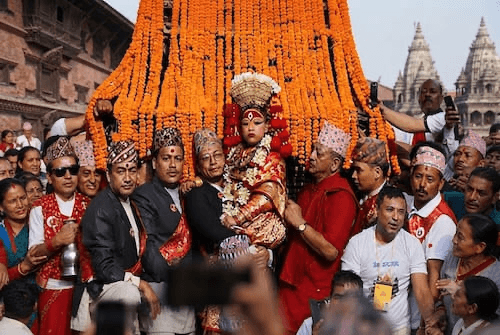
- Indra Jatra
- Yenya Punhi
- Indrotsava
Famous temples of Devaraja Indra
- Indal Dev Temple, Majhapara, Kharaud Nagar, Chhattisgarh
- Sureshwari Devi Temple, Haridwar, Uttarakhand
- Indrali Temple, Udupi, Karnataka
- Indreshwar Temple, Pandharinath, Indore