
Lord Bhairava (Lord Kalabhairava)
Lord Bhairava, the fierce form of Shiva: the eight Bhairavas, the legend of Kalabhairava and the fifth head of Brahma, his iconography, mantras, festivals and temples.
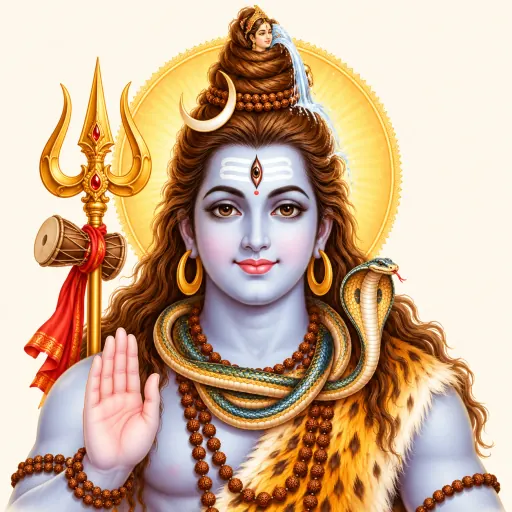
About Lord Bhairava
Lord Bhairava is described as a Raudra Rupa, a fierce form, of Lord Shiva. In Hinduism eight different forms of Lord Bhairava, known together as the Ashta Bhairava, are worshipped, and Kalabhairava is one of these eight forms. In the Brahmavaivarta Purana the eight Bhairavas are named Mahabhairava, Samhara Bhairava, Asitanga Bhairava, Rudra Bhairava, Kalabhairava, Krodha Bhairava, Tamrachuda Bhairava and Chandrachuda Bhairava.
This form of Lord Shiva as Kalabhairava is regarded as the presiding deity of time and death. The word Bhairava means "the terrifying and destructive one" or "the remover of fear". The worship of Lord Kalabhairava destroys all the known and unknown fears in the mind and gives victory over enemies. Kalabhairava is also worshipped for protection from evil spirits, ghosts and other harmful beings.
Night is generally considered the best time for his worship. Most devotees worship him on Sunday, Tuesday and Saturday. The Krishna Paksha Ashtami of every month is kept as Masika Kalashtami, and Kalabhairava Jayanti is kept on the Krishna Paksha Ashtami of the month of Margashirsha.
Origin of Lord Kalabhairava
According to the scriptures the legend of the origin of Lord Kalabhairava is as follows. Nandishvara said: "O Sanatkumara! Bhairava is the complete incarnation of the Supreme Lord Shiva. Once Lord Brahma was seated on Mount Sumeru. All the gods gathered there and, bowing to Brahma, asked: 'O Prajapati! What is the imperishable element of creation? Please tell us the ultimate truth of existence.' Under the influence of the illusion of Lord Shankara, Brahma, though he did not know the imperishable truth, began to describe it and said: 'O sages! There is no deity greater than me. I alone am the creator of this universe, the self-born, unborn, eternal enjoyer Brahma. I alone begin and withdraw creation. There is none above me in the whole universe.'"
Among those sages Lord Vishnu was also present. Hearing the self-praise of Brahma, Vishnu said: "O Brahma! What conduct is this? Remember well that it was by my command that you were established as the creator of the universe." So a debate began between Lord Vishnu and Lord Brahma about their superiority, and both began to cite Vedic statements to support their claims. At that moment the four Vedas appeared before them in bodily form. First the Rigveda said: "He in whom all beings exist, from whom all creation comes and who is known as the Supreme Principle, He alone is Rudra." Then the Yajurveda said: "He through whom our authority is established, who is worshipped through various sacrifices and yogic practices, the all-knowing and all-seeing, He alone is Lord Shiva." Then the Samaveda said: "He who deludes the whole world, whom the yogis seek, by whose radiance the universe is lit, He is none other than the three-eyed Shiva." Last the Atharvaveda said: "He who can be realised only by unwavering devotion, who is free from all suffering, He alone is the Supreme Lord Shiva."
Hearing the words of the Vedas, Lord Vishnu and Brahma said: "O Vedas! This is only your ignorance. How can Shiva, who always lives with Shakti, goes unclothed, is yellowish in complexion and is smeared with ash and dust, be the Supreme Principle?" Then the all-pervading Omkara said: "Lord Shiva is the bearer of Shakti. Without his power he cannot act. Though he is engaged in divine play, he alone is without doubt the Supreme Lord." Even these words did not satisfy Brahma and Vishnu, and their dispute went on.
Suddenly between them appeared a tremendously fierce and radiant column of light, a Prakasha Punja, without beginning or end. Its brilliance began to burn the fifth head of Brahma. At once the trident-bearing, blue-red Lord Shiva appeared. Brahma said to him: "O Neela Lohita, Chandramauli! Do not frighten me. I know you well. In ancient times you were born from my head, and because you cried I named you Rudra. O son, take refuge in me; I shall surely protect you." Hearing these proud words Lord Shiva became enraged and ready for dissolution. From his intense wrath a being named Bhairava came out. Lord Shiva commanded him: "O Bhairava! Discipline Brahma and uphold creation. You are like Time itself; therefore you shall be worshipped as Kalabhairava. O Lord of Time! Among all sacred cities Kashipuri is supreme. I appoint you its eternal guardian. You shall keep a record of all the sinners who live there."
Having received this boon, Kalabhairava cut off the fifth head of Brahma with the nail of a finger of his left hand. Distressed by his condition, Brahma began to recite the Shatarudriya. Vishnu and Brahma realised the truth and accepted Lord Shiva as Parabrahma Paramatma, the Supreme Absolute. When their pride was destroyed Lord Shiva gave them fearlessness. Then Lord Shiva instructed Kalabhairava: "O Neela Lohita! Honour Brahma and Vishnu and wander as a mendicant carrying the skull of Brahma, to free yourself from the sin of Brahma Hatya." Lord Shiva then brought forth a maiden named Brahma Hatya, and said to Kalabhairava: "Go to Kashi before this maiden comes there, and tell her to wander in any place other than Varanasi. After wandering in all places this maiden will return to Kashi, and then she will be liberated." Since then, by the command of Lord Shiva, Kalabhairava lives in Kashi, and so he is known as the Kotwal of Kashi.
So Lord Shiva appeared as Kalabhairava to destroy the pride of Brahma and Vishnu, to give them the knowledge of the Supreme Truth and to settle their dispute about superiority.
Iconography of Lord Kalabhairava
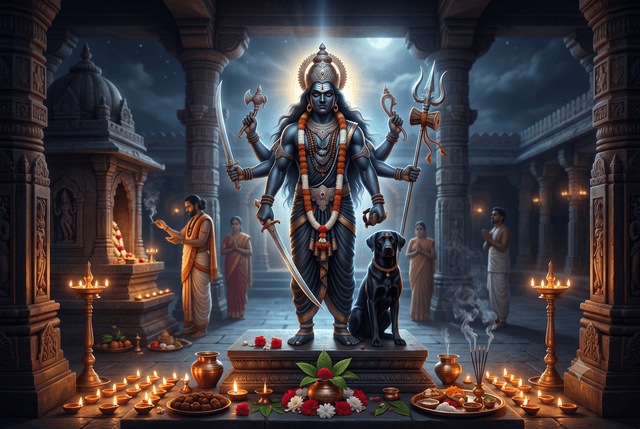
Kalabhairava is described as extremely terrifying and fearsome. He is dark and bluish in complexion, with eyes blazing with the fire of anger, and his head is adorned with matted locks. He wears a Gajacharma or Baghambara, an elephant hide or a tiger skin, though in some pictures he is shown naked. Serpents adorn his body as the sacred thread and the waist-belt, and he wears a Munda Mala, a garland of skulls, round his neck. He is usually shown four-armed, holding a trident, a noose, a staff and an axe. His vehicle is a dog, which symbolises Maya, the great illusion.
Family of Lord Kalabhairava
Lord Kalabhairava is a self-manifested incarnation of Lord Shiva, and so no separate family is described for him. Goddess Parvati is the consort of Lord Shiva, and Lord Ganesha and Lord Kartikeya are his sons.
Mantras of Lord Kalabhairava
ॐ कालभैरवाय नमः।
Om kalabhairavaya namah|
ॐ ह्रां ह्रीं ह्रौं कालभैरवाय नमः।
Om hram hrim hraum kalabhairavaya namah|
ॐ कालकालाय विद्महे कालातीताय धीमहि। तन्नो कालभैरवः प्रचोदयात्॥
Om kalakalaya vidmahe kalatitaya dhimahi| tanno kalabhairavah prachodayat||
Festivals of Lord Kalabhairava
- Masika Kalashtami
- Kalabhairav Jayanti
Famous temples of Lord Kalabhairava
- Kalabhairava Temple, Ujjain, Madhya Pradesh
- Kalabhairava Temple, Varanasi, Uttar Pradesh
- Batuka Bhairava Temple, New Delhi
- Kalabhairava Temple, Bhilwara, Rajasthan
- Shri Chaumukha Bhairavanath Ji, Dausa, Rajasthan
- Ghorakhal Bhairava Temple, Nainital, Uttarakhand
Related pages
 Kala Bhairava AshtakamThe eight verses in praise of Kalabhairava.
- Bhairava ChalisaThe forty verses in praise of Bhairava.
- Bhairava AartiThe words of the aarti of Bhairava.
- 1000 Kalabhairava NamesThe thousand names of Kalabhairava.
- 108 Batuka Bhairava NamesThe 108 names of Batuka Bhairava.
- Lord ShivaOf whom Bhairava is the fierce form.