
Goddess Durga (Mata Durga)
Goddess Durga: her origin as Sati and Ugrachandi, her family, her eight and eighteen armed forms, the Navratris and the Durgashtami in which she is worshipped, her mantras and her temples.
About Goddess Durga
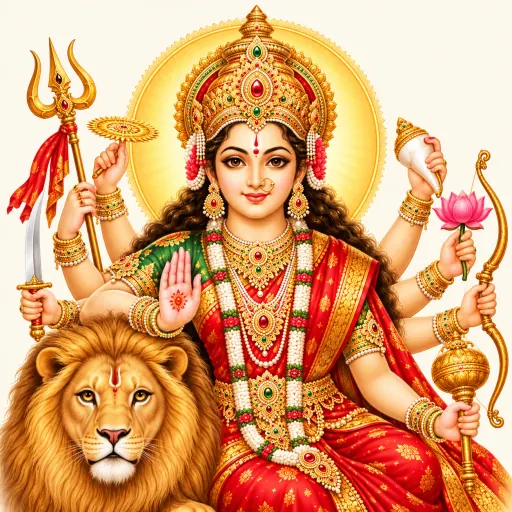
Goddess Durga is one of the principal goddesses of Hinduism. She is one of the five deities worshipped in the Panchadeva Upasana, in which Lord Ganesha, Lord Shiva, Lord Vishnu, the Sun God and Goddess Durga are worshipped. According to the Shrimad Bhagavata Mahapurana, Goddess Durga took birth to protect the righteous. After she slew the fearsome demon Durgama, Goddess Adya Shakti became known as Goddess Durga.
According to the Shrimad Devi Bhagavata Purana, Goddess Durga appeared to protect the Vedas and the Puranas and to destroy the demonic forces. As described in the Rigveda, Goddess Durga is the manifestation of Adi Shakti, the primordial energy that sustains the whole universe and who is eternal. An unmarried girl and a kalash are considered symbols of Goddess Durga. Jagadamba, Adi Shakti and Narayani are epithets of Durga. According to belief she governs all the celestial bodies of the solar system.
Origin of Goddess Durga
Goddess Durga is also known as Sati, who was born as the daughter of Daksha Prajapati. Daksha once held a grand yajna and invited all the gods and goddesses, but not Lord Shiva and Sati. Sati went to the yajna all the same, but when Daksha insulted Lord Shiva there, an enraged Sati took the form of Ugrachandi and destroyed the yajna.
Goddess Ugrachandi has an extremely fierce appearance with 18 arms. The followers of the Shakta Sampradaya and her devotees specially worship Ugrachandi on the Krishna Paksha Navami of the month of Ashwina by the Amanta calendar (Kartika by the Purnimanta calendar), to remember the manifestation of the Goddess on that day. Later Ugrachandi became known as Goddess Durga after she slew the demon Durgama.
Family of Goddess Durga
Goddess Durga is described as Shakti, the divine energy of Lord Shiva. According to belief, Goddess Parvati and Goddess Durga are the same divine mother. So Lord Ganesha and Kumar Kartikeya are the sons of Goddess Durga, and Ashoka Sundari, Jyoti and Manasa Devi are her daughters.
Iconography of Goddess Durga
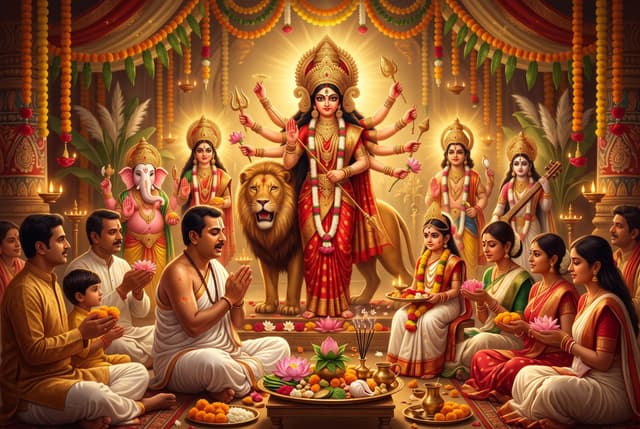
In the Hindu texts Goddess Durga is described with a blood-red, a yellow or a saffron complexion. In her eight-armed form she is shown mounted on a lion. In her eighteen-armed form she carries a trident, a discus, a mace, a bow, a conch, a sword, a lotus, an arrow, an axe, a rope, a noose, a spear, a shield, a drum, a cup, a bell and a rosary. One of her arms is raised in the Abhaya Mudra, the gesture that gives protection.
Worship of Goddess Durga
The festival of Navratri is regarded as the most important time for the worship of Goddess Durga. In the Hindu lunar year four Navratris are kept: Chaitra Navratri, Sharadiya Navratri, Magha Gupta Navratri and Ashadha Gupta Navratri. Sharadiya Navratri is the most popular and significant of the four, and so it is called Maha Navratri. In many parts of India Durga Puja is kept during the last five days of the Navratri.
Her devotees also keep a fast every month on the Shukla Paksha Ashtami, which is called Masika Durgashtami. The Ashtami of the month of Ashwina that falls during Sharadiya Navratri is renowned as Mukhya Durga Ashtami or Maha Ashtami.
Mantras of Goddess Durga
ॐ श्री दुर्गायै नमः।
Om shri durgayai namah|
ॐ दुं दुर्गाय नमः।
Om dum durgaya namah|
ॐ गिरिजायै च विद्महे शिवप्रियायै च धीमहि। तन्नो दुर्गा प्रचोदयात्॥
Om girijayai cha vidmahe shivapriyayai cha dhimahi| tanno durga prachodayat||
ॐ सर्वमङ्गलमङ्गल्ये शिवे सर्वार्थसाधिके।
शरण्ये त्र्यम्बके गौरि नारायणि नमोऽस्तुते॥
Om sarvamangalamangalye shive sarvarthasadhike|
Sharanye tryambake gauri narayani namoastute||
Salutations to you, O Narayani, the auspiciousness of all that is auspicious, Shiva, who accomplishes every purpose, the refuge, the three-eyed Gauri.
ॐ सर्वस्वरूपे सर्वेशे सर्वशक्तिसमन्विते।
भयेभ्यस्त्राहि नो देवि दुर्गे देवि नमोऽस्तुते॥
Om sarvasvarupe sarveshe sarvashaktisamanvite|
Bhayebhyastrahi no devi durge devi namoastute||
O Devi Durga, the form of all, the lord of all, endowed with all powers: save us from fear; salutations to you.
Festivals of Goddess Durga
- Durga Puja
- Chaitra Navratri
- Ashadha Gupta Navratri
- Shardiya Navratri
- Magha Gupta Navratri
- Durga Ashtami
Famous temples of Goddess Durga
- Shri Ambaji Temple, Gujarat
- Shri Dakshineswar Kali Temple, Kolkata
- Shri Durga Temple, Durga Kund, Kashi, Uttar Pradesh
- Shri Vaishno Devi Temple, Jammu and Kashmir
Related pages
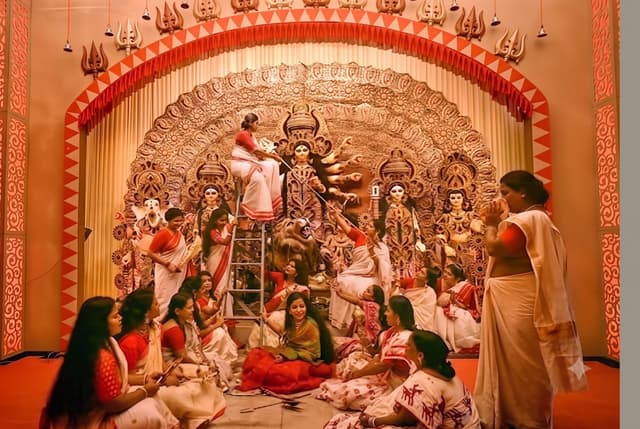 Durga Puja VidhiThe Durga Puja in sixteen steps.
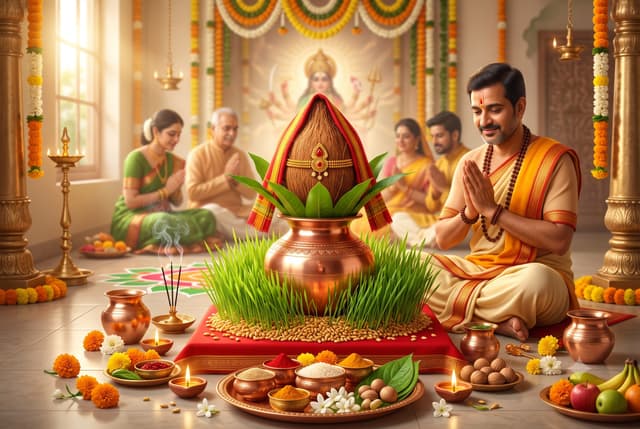 Ghatasthapana Puja VidhiThe setting of the kalash at the start of Navratri.
- Durga Homa VidhiThe Durga Havan at home.
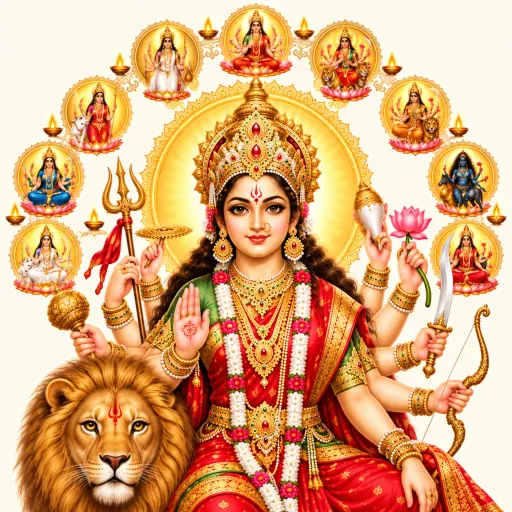 NavdurgaThe nine forms of Durga, one for each night.
 Masik DurgashtamiThe date of the monthly Durgashtami in any year.
- Durga MantrasThe mantras of Goddess Durga.
- Durga SaptashatiThe seven hundred verses of the Devi Mahatmya.
- Durga Mata AartiThe words of the aarti of Durga.
- Durga Mata ChalisaThe forty verses in praise of Durga.