The katha
Anjana was once an apsara in Indra's court who, for a playful fault, was cursed to be born on earth as a vanara woman; the curse would end when she bore a son who was a part of Shiva. She married Kesari, a vanara chief, and did long penance to Shiva for a child.
At that time King Dasharatha in Ayodhya was given divine payasam for his queens. A kite snatched a portion of it and flew off, and the wind god Vayu carried it to Anjana's outstretched hands as she prayed. She ate it, and in time bore a son with the strength of Shiva and the swiftness of the wind.
As a baby, Hanuman woke up hungry and saw the rising Sun, red like a ripe fruit. He leapt into the sky to eat it. Indra, seeing the Sun in danger, struck the child with his thunderbolt, and he fell to earth with his jaw (hanu) broken. Vayu, grieving, withdrew from the world, and all living things began to suffocate. The gods rushed to make peace. Brahma revived the child, and each god gave him a boon: no weapon would harm him, he could take any form, and he would live as long as he wished. Because of his jaw he was called Hanuman.
He later became the greatest devotee of Rama, leapt the ocean to find Sita, burned Lanka and carried the mountain with the Sanjivani herb. He is one of the seven deathless ones and is believed to be present wherever the Ramayana is read.
Keeping the fast
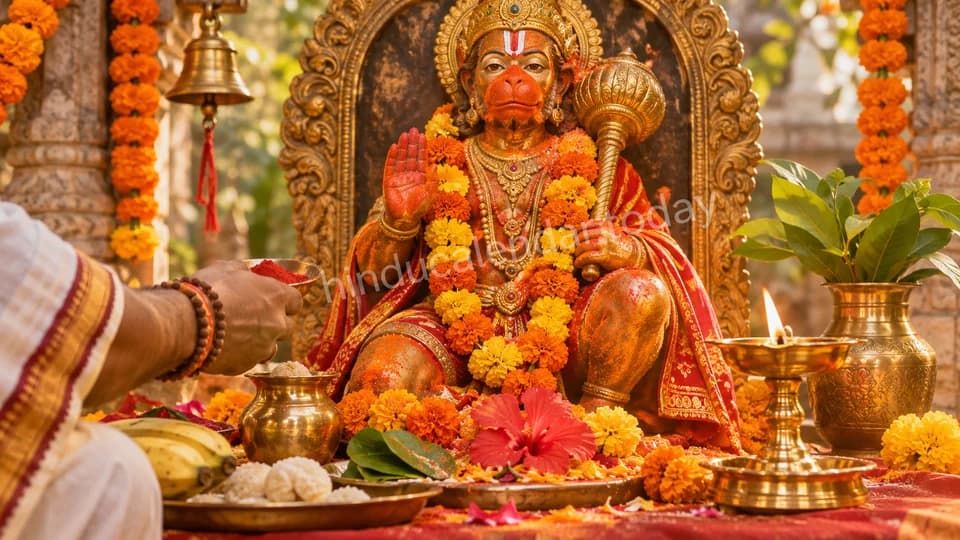
The day is kept with a fast until the hour of the birth, or until evening. The image is bathed, dressed and worshipped with flowers, sandal, incense, a lamp and the offerings dear to the deity, the katha is read and the aarti sung, and the fast is broken with the prasad.
The Hanuman Chalisa is recited, often a hundred and eight times, and the Sundarkand is read.