
Significance & Spiritual Meaning
Spiritual philosophy, inner meaning and eternal virtues
Krishna Janmashtami (also known as Krishnashtami, Gokulashtami, Yadukulashtami, or Srikrishna Jayanti) is one of the most revered and joyously celebrated festivals in Sanatana Dharma. It commemorates the earthly appearance of Bhagavan Shri Krishna—the supreme fountainhead of all avatars, the divine teacher of the Bhagavad Gita, and the protector of Dharma. According to the lunisolar Hindu calendar, the festival is observed on the Ashtami tithi (eighth day) of the dark fortnight (Krishna Paksha) in the holy month of Shravana (in the Amanta tradition) or Bhadrapada (in the Purnimanta tradition), coinciding with the auspicious Rohini Nakshatra. At the exact stroke of midnight (Nishita Kaal), when Lord Krishna manifested to liberate the world from tyrannical adharma, millions of devotees worldwide celebrate with conches, temple bells, devotional kirtans, and grand abhishekam ceremonies.
Krishna Janmashtami carries profound spiritual, philosophical, and cultural significance for humanity: 1. Restoration of Dharma: Lord Krishna’s incarnation embodies the immortal promise of the Bhagavad Gita (4.7-8) that whenever righteousness declines and unrighteousness rises, the Divine descends to protect the virtuous and re-establish truth. 2. The Path of Karma Yoga: Lord Krishna gifted the universe the timeless wisdom of selfless action—performing one’s sacred duty with devotion without attachment to selfish rewards. 3. Prema Bhakti & Grace: Celebrating Janmashtami with heartfelt fasting and remembrance dissolves accumulated karmas, bestows progeny to the childless, and awakens divine love (Prema Bhakti) in the heart.
Sacred Story & Divine Lore
Scriptural history and divine legends in sacred lore
“Born in a dark Mathura prison where his parents Devaki and Vasudeva were captive under tyrant King Kansa, infant Krishna was miraculously carried across the roaring Yamuna to Gokul by Vasudeva, sheltered from torrential rains by the multi-hooded serpent Sheshanaga, ensuring his safe upbringing in the loving home of Yashoda and Nanda Baba.”
Key Rituals & Observance
Step-by-step sacred rituals and worship practices
- 1Step 1
Nirjala (waterless) or Phalahari (fruit-based) fasting from sunrise through the day until midnight.
- 2Step 2
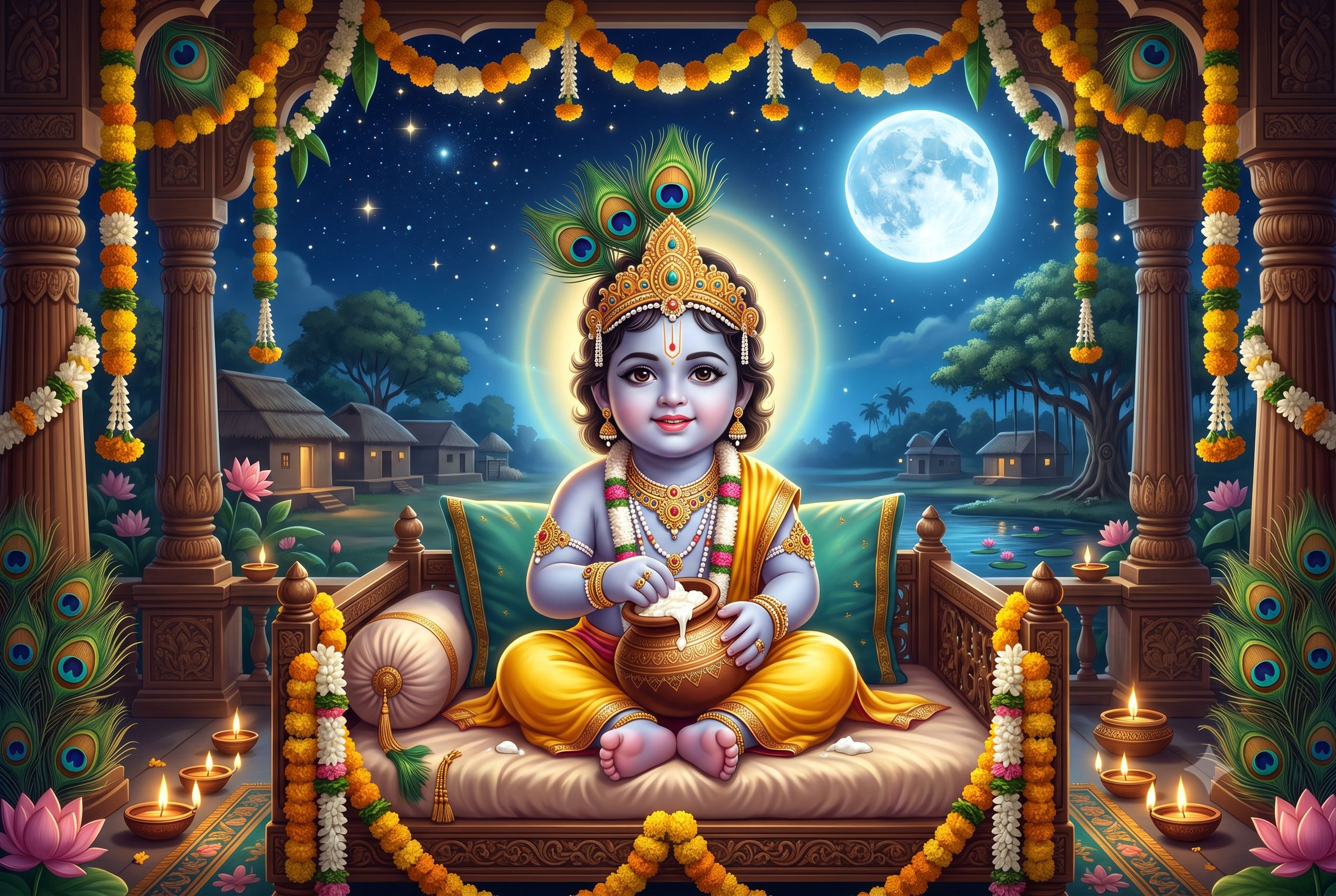
Cleaning and adorning home shrines with flowers, miniature replica gardens (Jhankis), and decorated cradles (Jhula) for Bal Gopal.
- 3Step 3
Continuous recitation of Shrimad Bhagavad Gita, Vishnu Sahasranama, and Shrimad Bhagavatam (Book 10).
- 4Step 4
Midnight Nishita Kaal Maha-Abhisheka of Laddu Gopal with milk, curd, ghee, honey, and sacred Gangajal.
- 5Step 5
Offering fresh Makhan (white butter), Mishri, Tulsi leaves, and Chappan Bhog (56 culinary delicacies).
- 6Step 6
Midnight Janmotsav Aarti followed by breaking fast (Parana) with Charanamrit and prasad.
Sacred Deity & Powerful Mantras
Lord Krishna (Bhagavan Shri Krishna) • Vedic and Puranic chants for peace and blessings
Maha-Mantra (महामंत्र)
हरे कृष्ण हरे कृष्ण कृष्ण कृष्ण हरे हरे । हरे राम हरे राम राम राम हरे हरे ॥
Hare Krishna Hare Krishna Krishna Krishna Hare Hare, Hare Rama Hare Rama Rama Rama Hare Hare
Krishna Gayatri Mantra (श्रीकृष्ण गायत्री मंत्र)
ॐ देवकीनन्दनाय विद्महे वासुदेवाय धीमहि । तन्नो कृष्णः प्रचोदयात् ॥
Om Devakinandanaya Vidmahe Vasudevaya Dhimahi, Tanno Krishnah Prachodayat
Krishna Janma Shloka (जन्माष्टमी स्तुति)
वसुदेवसुतं देवं कंसचाणूरमर्दनम् । देवकीपरमानन्दं कृष्णं वन्दे जगद्गुरुम् ॥
Vasudeva-Sutam Devam Kamsa-Chanura-Mardanam, Devaki-Parama-Anandam Krishnam Vande Jagadgurum
Kasturi Tilakam (श्रीकृष्ण ध्यान श्लोक)
कस्तूरीतिलकं ललाटपटले वक्षःस्थले कौस्तुभं नासाग्रे नवमौक्तिकं करतले वेणुं करे कङ्कणम् । सर्वाङ्गे हरिचन्दनं सुललितं कण्ठे च मुक्तावलिः गोपस्त्रीपरिवेष्टितो विजयते गोपालचूडामणिः ॥
Kasturi-Tilakam Lalata-Patale Vakshah-Sthale Kaustubham, Nasagre Nava-Mauktikam Karatale Venum Kare Kankanam
Shri Kunj Bihari Aarti (श्री कुंजबिहारी की आरती)
Devotional verses and traditional stuti for prayer
आरती कुंजबिहारी की, श्री गिरधर कृष्ण मुरारी की ॥
गले में बैजंती माला, बजावै मुरली मधुर बाला ।
श्रवण में कुण्डल झलकाला, नंद के आनंद नंदलाला ।
गगन सम अंग कांति काली, राधिका चमक रही आली ।
लतन में ठाढ़े बनमाली, भ्रमर सी अलक, कस्तूरी तिलक,
चंद्र सी झलक, ललित छवि श्यामा प्यारी की ॥
श्री गिरधर कृष्ण मुरारी की, आरती कुंजबिहारी की ॥
Regional Celebrations & Heritage
Diverse cultural and spiritual traditions across Bharat and worldwide
Pilgrims from across the world gather at Krishna Janmasthan Temple in Mathura and Banke Bihari Temple in Vrindavan. The entire region resounds with Raslila dance-dramas, midnight Panchamrit Mahabhisheka with silver conches, and 24-hour Akhand Kirtan.
On the day following Janmashtami (Nandotsav), spirited youth groups (Govindas) construct towering multi-tier human pyramids to reach and shatter clay pots (Handis) filled with curd, butter, and fruits suspended high above city streets, reenacting young Krishna’s butter-stealing pastimes.
At the grand Dwarkadhish Temple and Nathdwara Shrinathji temple, thousands gather for gold and diamond Shringara darshan, playing traditional Garba and Raas folk dances into the early morning hours.
Families draw delicate rice-flour footprints of baby Krishna leading from the home entrance into the puja room. Special traditional savories and sweets like Seedai, Murukku, Thattai, and Aval (puffed rice with jaggery) are offered with fresh butter.
In Assam, community prayer halls (Namghars) echo with Sankaradeva’s devotional Borgeet and Ankia Naat. In Manipur, classical Manipuri Raas Leela is performed in exquisite traditional costumes portraying Radha-Krishna devotion.
Observed as a national holiday in Nepal with thousands visiting the ancient Patan Krishna Temple. Millions attend ISKCON temples across London, New York, Durban, and Sydney for midnight Abhisheka and Chappan Bhog distribution.
Traditional Bhog & Sacred Offerings
Sacred food offerings prepared with devotion