The katha
A wealthy merchant had every comfort but no son. He fasted every Monday and worshipped Shiva in the evening. Moved by his devotion, Parvati asked Shiva to grant his wish. Shiva said that the merchant's past deeds gave him no son, but at her pleading he granted one whose life would last only twelve years. The merchant was told this in a dream; he neither rejoiced nor grieved, and kept on with his Mondays.
When the boy turned eleven the merchant sent him to Kashi to study, with his maternal uncle and enough money to feed Brahmins along the way. In one town they found a princess being married to a prince who was blind in one eye; his father, afraid of the shame, persuaded the merchant's handsome son to sit in the groom's place. The boy agreed, but wrote on the princess's veil that he was only standing in, and the princess refused to go with the real prince.
In Kashi, on the day he turned twelve, the boy fell ill and died. His uncle's weeping reached Shiva and Parvati as they passed, and Parvati begged Shiva to restore him. Shiva gave him back his life for the sake of his father's Mondays. On the way home the princess's father recognised him and sent his daughter with him. The merchant and his wife, who had resolved to die if their son did not come back, were on their rooftop when he arrived. That night Shiva told the merchant in a dream that his fasts and his listening to the katha had won his son a long life.
Keeping the fast
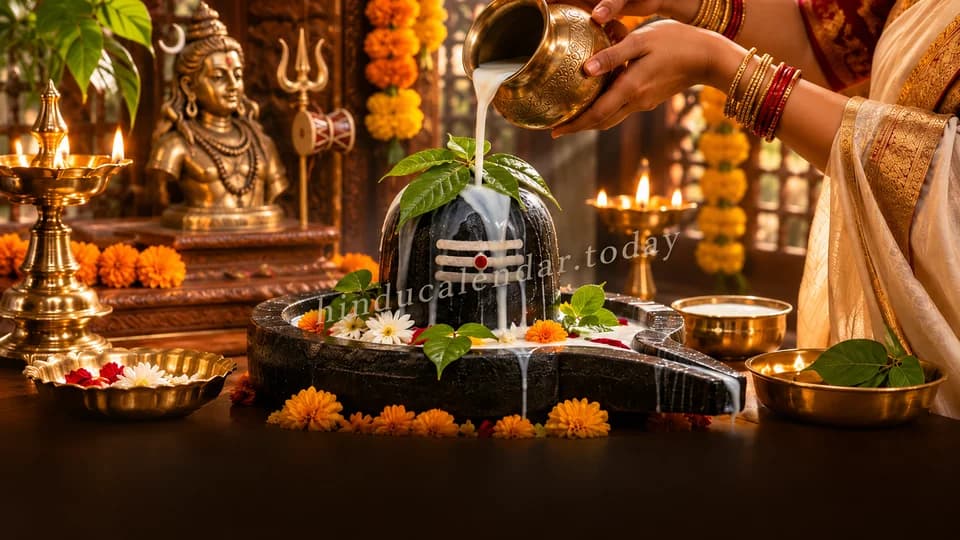
Water and milk are poured on the Shivalinga, bilva leaves and white flowers are offered and the mantra Om Namah Shivaya is repeated. Food is taken once after the evening worship. The katha is followed by the aarti of Shiva.