
Goddess Ganga (Maa Ganga)
Maa Ganga: the river as goddess, her origin and the descent through the locks of Shiva, her family, how she is shown, her mantras and the festivals and temples of the river.
About Goddess Ganga
In Hinduism the river Ganga is regarded as extremely sacred and meritorious, and she is worshipped as Goddess Ganga. Her devotees lovingly call her Maa Ganga. According to the Hindu scriptures she is known as Mandakini in the heavenly realms and as Bhagirathi in the netherworld. The earliest reference to Goddess Ganga is in the Rigveda, where she is described as the most sacred of rivers. Her glory is told in many ancient texts, among them the Ramayana and the Mahabharata, and among the people many beliefs and customs connected with Ganga are widespread.
Followers of Hinduism customarily immerse the remaining ashes of their dead in the river Ganga after the final rites. According to the common belief this gives Moksha, liberation, to the departed soul, frees it from the cycle of birth and death and lets it merge in the divine feet of the Supreme Lord. Hindus believe that a bath in the sacred waters of the Ganga washes away all sins and makes a person completely pure. Through the year there are many auspicious occasions on which a bath in the Ganga brings immeasurable spiritual merit. Charity, sacrifice, yajna, chanting and penance done on the banks of the Ganga also bear manifold fruit.
The Ganga is an inseparable part of Indian civilisation, culture and society. Many sacred cities, such as Haridwar, Prayagraj and Varanasi, stand on the banks of the holy Ganga.
Origin of Maa Ganga
According to the Ramayana Goddess Ganga was born to Himavana, the king of the mountains, as his first daughter, and she is the sister of Goddess Parvati. Some other religious texts say that Goddess Ganga appeared from the sacred feet of Lord Vishnu.
In the old legends of the descent of Ganga there once lived a king named Sagara who had sixty thousand sons. One day King Sagara held a great yajna to establish his supremacy over the heavens, and a sacrificial horse was needed for the rite. Indra, the king of the gods, stole the horse and hid it. King Sagara sent all his sons to look for it, and at last they found it in the netherworld, tied near the hermitage of the sage Kapila. Seeing the horse there, the sons of Sagara thought the sage had stolen it and began to abuse him in harsh words. The sage Kapila had been deep in penance for thousands of years. As soon as he opened his eyes a fierce divine fire came out of them and turned all sixty thousand sons of King Sagara to ashes.
Because they were burnt by the divine fire of the sage Kapila, the sons of Sagara could not be given the funeral rites prescribed in the scriptures, and so their souls wandered restlessly like spirits. Anshuman, the grandson of Sagara, did severe penance for the liberation of the souls of his ancestors. After him his son King Dilipa also did hard austerities, but without success. Later Bhagiratha, the son of Dilipa by his second wife, vowed to bring Maa Ganga down to the earth for the salvation of his ancestors, and sat in deep penance.
Bhagiratha did austerities for many years to please Lord Brahma, that Goddess Ganga might come down to earth. Pleased with his devotion Lord Brahma appeared before him and asked him to ask a boon, and Bhagiratha asked that Ganga be sent to earth to free his ancestors. Goddess Ganga then said that if she came down directly from so great a height the earth would not be able to bear her immense force, and nature might fall out of balance. To solve this problem Bhagiratha prayed to Lord Shiva and asked him for a solution. Lord Shiva held Goddess Ganga in his matted locks, held back her great force and then let her out gently through a single lock of his hair. In this way the pure, sacred and unbroken stream of the Ganga began to flow on earth.
Bhagiratha went ahead and the river followed him all the way to the confluence at Ganga Sagara. There the sons of King Sagara and the ancestors of Bhagiratha were liberated. By the divine touch of Lord Shiva Goddess Ganga became even more sacred and began to destroy the sins of all living beings.
Family of Maa Ganga
The father of Goddess Ganga was Himavana, the king of the mountains, and her mother was Menavati, but she was brought up under the care of Lord Brahma. So Goddess Parvati is the sister of Goddess Ganga, and she has a brother known in all the worlds, Mount Mainaka. According to the Mahabharata Goddess Ganga married King Shantanu, and had a son named Devavrata. Later, because of his vow of lifelong celibacy, Devavrata became famous as Bhishma.
Iconography of Maa Ganga
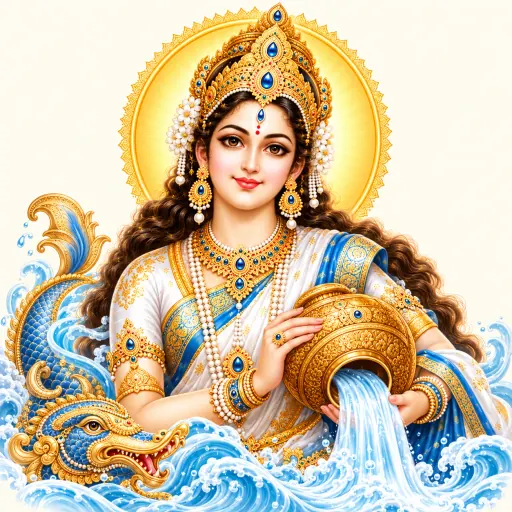
Goddess Ganga is fair-complexioned and is shown in white clothes. She sits on a beautiful Makara, the mythical water creature or crocodile, with a serene and peaceful expression on her face.
Mantras of Maa Ganga
देवि सुरेश्वरि भगवति गङ्गे त्रिभुवनतारिणि तरलतरङ्गे।
शङ्करमौलिविहारिणि विमले मम मतिरास्तां तव पदकमले॥
Devi sureshvari bhagavati gange tribhuvanatarini taralatarange|
Shankaramauliviharini vimale mama matirastam tava padakamale||
Salutations to Goddess Ganga. O divine mother, supreme among goddesses, whose gentle waves free the three worlds, who play on the crown of Shankara, O pure one: may my mind rest for ever at your lotus feet.
ॐ नमो गङ्गायै विश्वरूपिण्यै नारायण्यै नमो नमः॥
गङ्गा गङ्गेति यो ब्रूयाद् योजनानां शतैरपि।
मुच्यते सर्वपापेभ्यो विष्णुलोकं स गच्छति॥
Om namo gangayai vishvarupinyai narayanyai namo namah||
Ganga gangeti yo bruyad yojananam shatairapi|
Muchyate sarvapapebhyo vishnulokam sa gachchhati||
Salutations to Ganga, the form of the universe, Narayani. He who says "Ganga, Ganga" even from a hundred yojanas away is freed from all sins and goes to the world of Vishnu.
गाङ्गं वारि मनोहारि मुरारिचरणच्युतम्।
त्रिपुरारिशिरश्चारि पापहारि पुनातु माम्॥
Gangam vari manohari muraricharanachyutam|
Tripurarishirashchari papahari punatu mam||
The water of the Ganga, which charms the heart, which fell from the feet of Murari and moves on the head of Shiva, which takes away sins: may it purify me.
ॐ भागीरथ्यै च विद्महे विष्णुपत्न्यै च धीमहि। तन्नो गङ्गा प्रचोदयात्॥
Om bhagirathyai cha vidmahe vishnupatnyai cha dhimahi| tanno ganga prachodayat||
Festivals of Maa Ganga
- Ganga Dussehra
- Ganga Jayanti
- Loi Krathong Festival, Thailand
Famous temples and places of Maa Ganga
- Gangotri Dham, Uttarkashi, Uttarakhand
- Haridwar, Uttarakhand
- Prayagraj, Uttar Pradesh
- Varanasi, Uttar Pradesh
- Kali Ghat, Kolkata, West Bengal
தொடர்புடைய பக்கங்கள்
- Ganga Mata AartiThe words of the aarti of Maa Ganga.
- Ganga Mata ChalisaThe forty verses in praise of Ganga.
- 108 Ganga NamesThe 108 names of Ganga to chant.
- 1000 Ganga NamesThe thousand names of Ganga.
- Shri Ganga AshtakamThe eight verses in praise of Ganga.
- Ganga Mata StotramThe hymn of praise of Mother Ganga.
 Ganga Dussehra StotramThe hymn recited on Ganga Dussehra.